The bracket that survives where the conventional part fails.
solver run · check these numbers against their artifacts
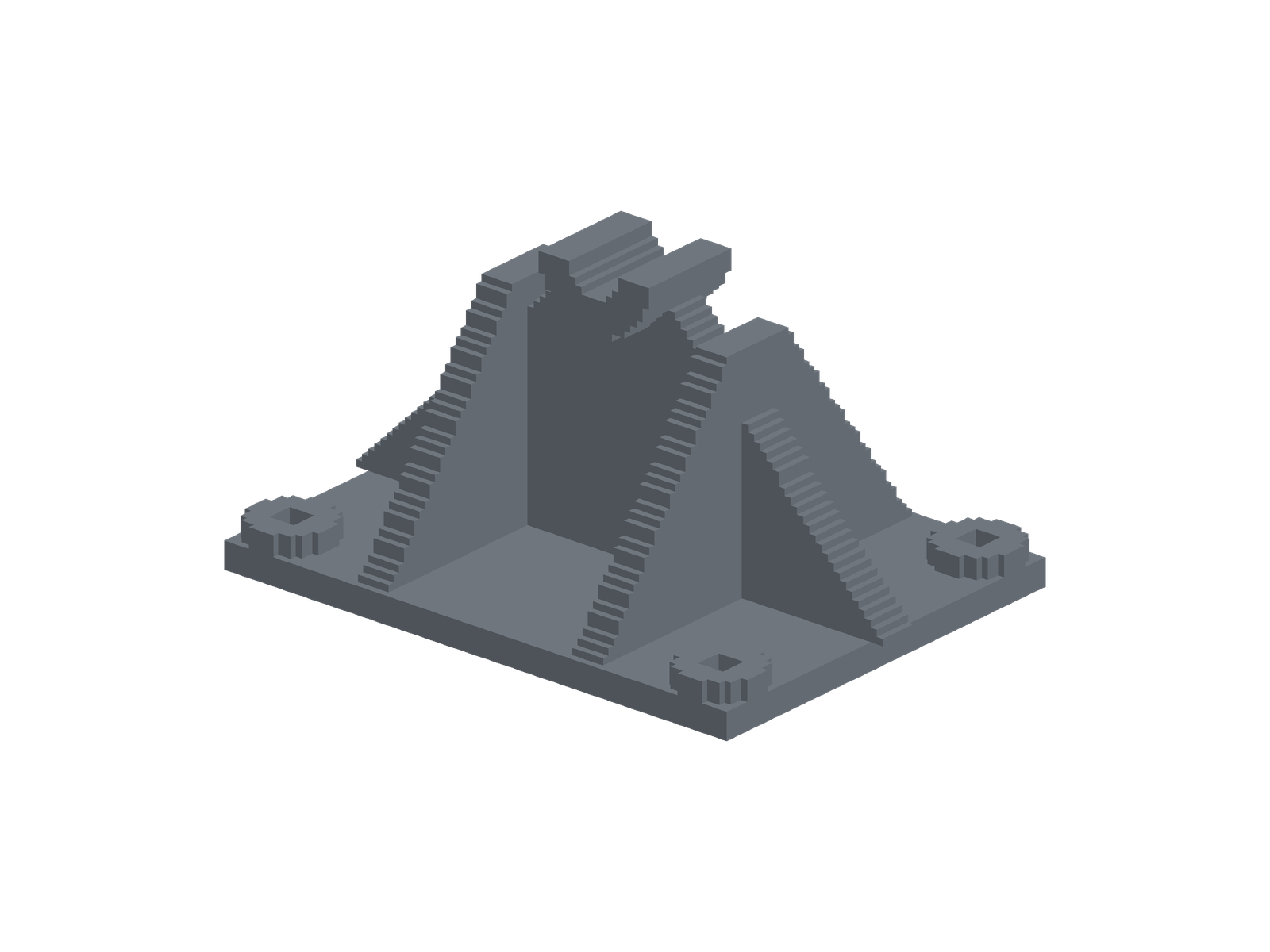
An additively-manufactured payload-interface bracket for a declared, generic 200 kg-payload rotorcraft load envelope — evolved from scratch, certified by the same solver and material as its conventional baseline.
The setup
The 200 kg payload figure is a public scale anchor. The envelope, load factors and torque were frozen in a preregistration before the first generation ran — they are PIE-declared generic values, not any manufacturer's. The claim could not be adapted to the result.
- Load cases (all evaluated, worst case governs): +3.5 g vertical, −1 g vertical, ±1.5 g lateral / fore-aft, 500 N·m torsion about the mount axis
- Safety-factor bar: 1.5 against the engine's AlSi10Mg yield strength (LPBF as-built material library entry)
- Boundary conditions: bearing loads at the bolt bores, not clamped faces
- Manufacturability: LPBF gates — local wall thickness, trapped voids, powder access, support fraction
The result
| Conventional plate-and-gusset | PIE bracket g00095 | |
|---|---|---|
| Governing case | torsion | torsion |
| Governing safety factor | 0.427 — fails | 2.055 — passes |
| Worst other case | fore-aft, SF 1.64 | vertical +3.5 g, SF 7.40 |
| First structural mode | 54.4 Hz | 171.6 Hz |
| Mass | 0.946 kg | 1.165 kg |
| Printable (LPBF gates) | fails support gate | passes all gates |
Both columns: CalculiX static + eigenfrequency on Gmsh tetrahedral meshes, identical load cases, identical AlSi10Mg material properties (same engine material-library entry). validated_sidecar
The honest trade, stated plainly: the evolved bracket is 23% heavier. This is not a lightweighting result. It is a survives-the-full-envelope result: the conventional design fails torsion outright at less than half the required safety factor, and the evolved part clears every declared case with margin. When a certified mass win exists, it will appear here with the same receipts. It does not exist today.
What was preregistered
Envelope, load cases, excitation spectrum, safety-factor bar, the fixed
baseline, and the exact claim ceiling — frozen in
bracket_demonstrator_prereg.json before iteration 1.
The preregistration also lists what this campaign may never claim:
flight or production readiness, a fatigue life, or a percent-lighter headline
unless the candidate beats the baseline on every gate.
{
  "candidate_id": "bracket_g00095_21d1fa03afc24",
  "evidence_tier": "validated_sidecar_calculix_gmsh",
  "governing_case": "torsion",
  "governing_safety_factor": 2.0554,
  "load_cases": [
    { "case": "vertical_+3.5g", "safety_factor": 7.4004 },
    { "case": "vertical_-1g",   "safety_factor": 25.9015 },
    { "case": "lateral_1.5g",  "safety_factor": 24.8130 },
    { "case": "foreaft_1.5g",  "safety_factor": 10.7075 },
    { "case": "torsion",       "safety_factor": 2.0554 }
  ],
  "passes": true, "failures": []
} Every number above traces to a CalculiX output inside a hashed, append-only ground-truth ledger record.
Back to evidence Run this on your component