Geometry, from crystal lattices to power grids.
Geometry is the universal substrate. If a thing has a shape and a physics ruler can judge that shape, PIE can evolve it — at any scale. Fifteen physics families run on the same engine today, and every one is listed below with the evidence tier it has actually earned. The tier is the claim; nothing here is graded above its ruler.
Inventory counted on 2026-08-11 from the executor registry and a full campaign-surface audit. The registry has been regenerated since; this page has not been recounted against it, so read the family list as the state on that date rather than today. Numbers with a badge are machine-traced to solver artifacts; family lists are qualitative by design.
Crystals and molecules.
PIE evolves crystal microstructures judged by machine-learned interatomic potentials (CHGNet, MACE) ML potential — screening, and molecular graphs and delivery-conjugate architectures screened by chemistry rule priors plus RDKit/ADMET sidecars proxy + sidecar screen. The quantum-chemistry ruler is answer-key checked: HOMO–LUMO gaps reproduce frozen GFN2-xTB references within 0.08–2.65%.
Stated plainly: this scale is a screening capability. No docking, no binding-affinity, no MD claims — candidates leave this layer as ranked hypotheses for real assays, not as results.
Architected matter.
The engine's home turf: TPMS lattices, CPPN implicit fields, L-system strut networks, graph scaffolds — evolved against stiffness, strength, surface density, permeability, conductivity and printability at once, then homogenized by real solvers: CalculiX FEM validated_sidecar and D3Q19 lattice-Boltzmann pore flow.
- 2D structural core vs published SIMP reference, re-scored by an independent FEM: within 1.66% recompute-verified
- MBB beam: PIE's structure at compliance ratio 0.9893 of the published reference — a hair stiffer, pass bar ≤ 1.10 recompute-verified
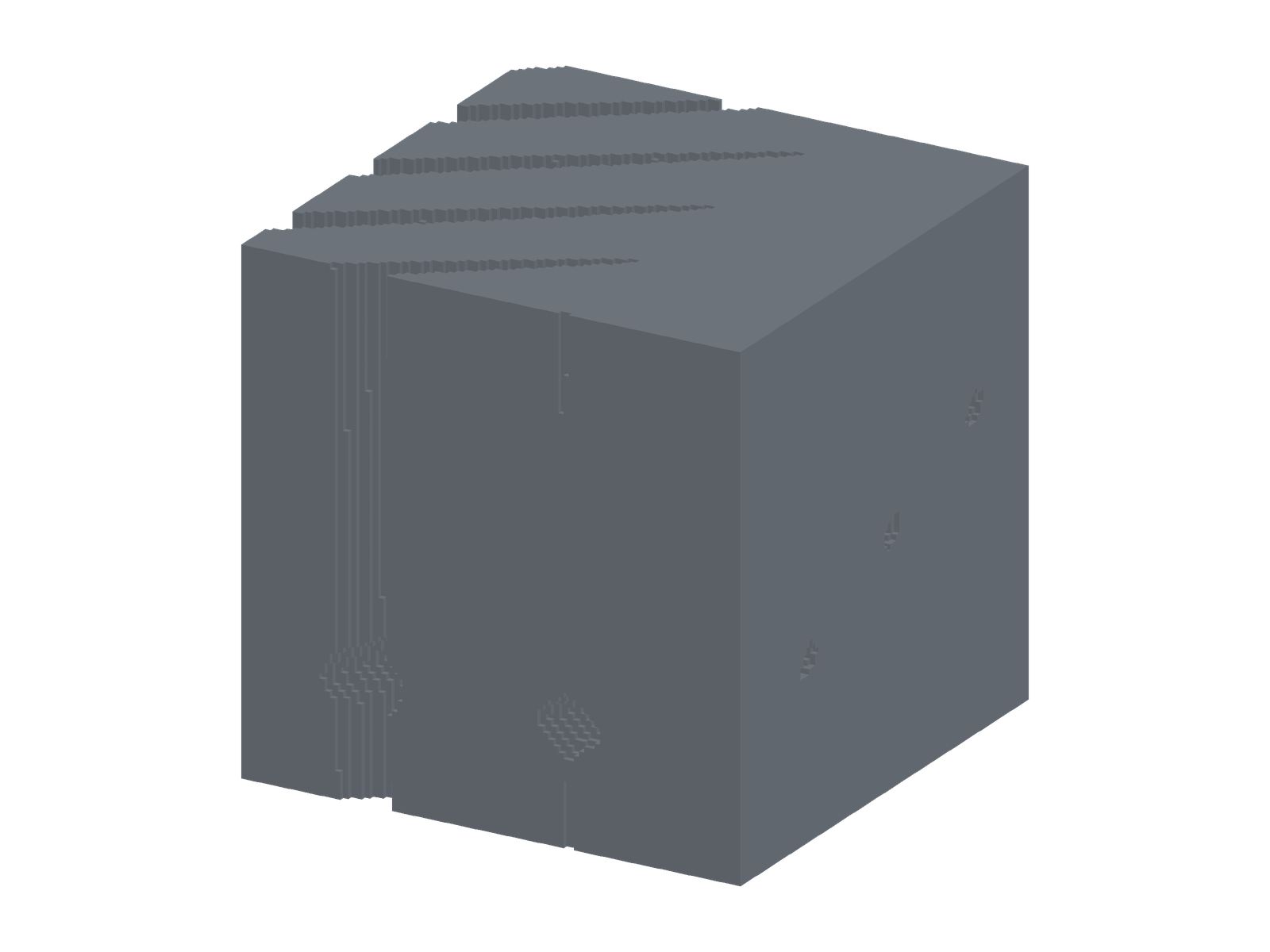
- 3D voxel FEM vs an independent from-scratch solver: 0.00% code-to-code on cube and laminate known answers
Components you can print and test.
Where the evidence chain runs deepest: the payload bracket (governing torsion SF 2.055 vs 0.427 for the conventional design CalculiX-certified) and the Inconel 625 sector coupon (axial E 136.72 GPa CalculiX-certified, print-ready). Also at this scale: analytical structural lattices and tubes, solar-thermal stills and condenser cassettes, mirror facets and concentrator optics analytical proxy, granular hopper internals judged by discrete-element simulation, and airfoil sections — where PIE's trust ladder (fast model explores, forced-transition XFOIL selects, certified CFD confirms) exists precisely because the fast models lie: we publish the mirages it catches, not the proxy's wins.
Networks, grids and machines.
The same evolutionary machinery, where the "geometry" is a network's topology and sizing:
- Water networks. PIE's in-house hydraulic solver agrees with real EPANET within 0.0143 m of head across every node of the published Hanoi network recompute-verified — and PIE's evolved Hanoi design lands within +0.269% of the best-known cost from three decades of published optimization, fully feasible on real EPANET. Stated as a match, not a beat.
- Power grids. Transmission topology, generator siting and conductor sizing evolved with a real AC load-flow solver (pandapower) judging every candidate in the loop validated_sidecar.
- Circuits and machines. DC circuits by modified nodal analysis; and a generalized multi-physics port-graph where electrical, mechanical, hydraulic and thermal elements couple in one system matrix regime solver — PIE evolves the machine's topology, physics solves the whole coupled system.
- Process flowsheets. Heater–cooler–flash chains with real vapor–liquid equilibrium thermodynamics regime solver.
Dynamical systems — the geometry of behavior.
Not everything PIE evolves is a solid. System-dynamics models (epidemics, predator–prey, chemical oscillators) integrated by RK4, and agent-based ecosystems, run as first-class evolution environments regime solver. The genome is the system's structure; physics integrates its behavior; survival is judged on the trajectory.
Every scale, the same rules.
At every scale, generators propose and physics disposes. No LLM, no surrogate, no request text ever promotes a candidate.
Every family above carries its honest tier — screening, analytical proxy, regime solver, or validated sidecar. The tier caps the claim, on this page and everywhere else.
Hundreds of registered verification checks run in CI across all of it — the same launch gates, ledgers and claim compiler for a crystal as for a power grid.